The Brief
For our Unit 2 ‘Live Brief’ we were set a site-specific curatorial project to put together a presentation for a hypothetical exhibition at St Pancras Old Church.
We worked in groups, and were advised to share roles and responsibilities for our presentation which we would then present to the client. I offered to format the presentation, and collate everyone’s contributions. This lead me to take on the role of a sort of project manager, dividing up sections of the presentation between my group and I. The group, formed of myself and two others – felt our works were connected through a personal-social context, being that they were all linked to identity and self-expression.
I formatted the presentation itself in Adobe InDesign, after drafting the initial statements for each slide in my Notes app. For each slide I consulted my group via our dedicated group chat; ensuring they were happy with what I had drafted up, and asking for constructive feedback; they responded each time saying they were in agreement on what was stated.
As I felt there was some clarity needed (for my own mind, at least) from other members of my group, in order for our presentation to better encapsulate their ideas and concepts, I asked for them to each draft their own information/ blurb for the slides showing their work and ideas. This felt a fair way of doing things, as I didn’t want to assume to know someone’s full concept and misinform people, or leave out any important details.
I also requested help with some of the historical, and the architectural aspects of St Pancras Old Church – I was aware that Art History in particular is a keen interest of one of my group members, and so it felt fair and logical to delegate some more of the research tasks to her.
Another member of my group was finding it difficult to express themselves through written words, and so I suggested perhaps they could use more photographs within the presentation, and expand on things verbally during the pitch if she felt comfortable to – which she said she did and so this became her approach.
The Presentation
When it came to delivering the presentation itself, I was aware that both members of my group were feeling nervous about the prospect of delivering a presentation to a room of other people, albeit artists and peers. I was also a little nervous, but fortunately have quite a lot of prior experience in public speaking, and so I felt I knew how to prepare myself. I wrote notes on my iPad before the presentation, so that I could refer back to those and give more explanation to slides that were at the same time being projected onto the wall behind us.
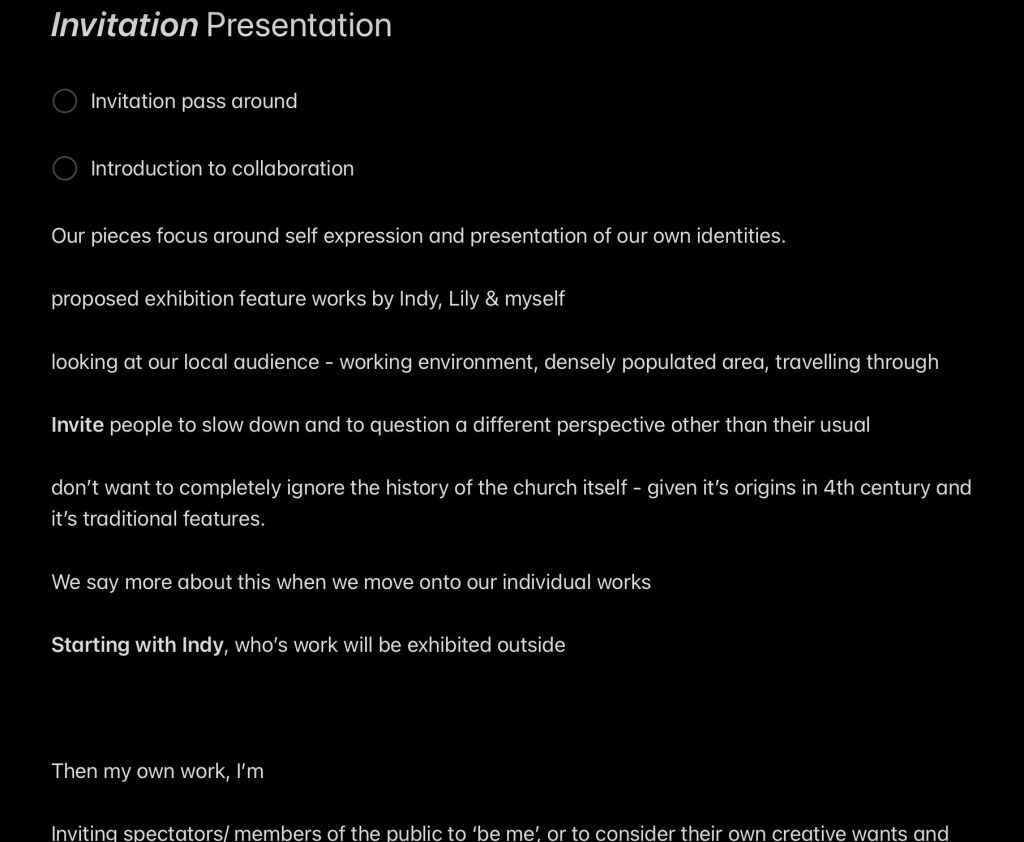
An additional aspect of our presentation were invitations we handed out as we began. This element was an idea sparked by two initiatives – firstly I thought it would be a simple, kind gesture to ensure our group’s presentation was memorable; secondly I assumed that both other members of my group would no doubt enjoy co-designing the invitation itself. I asked one person if she would be willing to create a design for the front, and the other person to create a design for the back, which would accompany some text, detailing a little more information on our exhibition such as the proposed dates, the overall concept, and who each of the artists with work featured were.
Feedback
Feedback we received included the client saying they really enjoyed receiving their own invitation, and a few of my classmates, separately, complimented me on my public speaking skills.
Following the presentation my group and I gave, some constructive feedback on how my work in particular engages with, and relates to the space (St Pancras Old Church) was provided, in that it was unclear what context (other than personal) I was working with – given that our work was to be presented in a church, within a busy community, and alongside other pieces which had made better sense, and use of their specific locations on site. This is something I can understand, and agree with, and so I decided to address this feedback in my reflective points.
Reflection
I usually shy away from bigger responsibilities within group projects and so it felt a tad overwhelming at times to have a few different active roles within my group. I took on the role of project manager, and tried to ensure each member of my group felt their ideas were accurately represented. I did this by requesting they, and myself, write a short description of our work/s to be exhibited. I wanted this information to be able to present and display our ideas effectively. I also then put together my group’s presentation using Adobe InDesign.
A difficulty I encountered with this process was trying to manage my time, on top of other people’s, and fair/ expected contributions from the rest of the group. A way I found to deal with this difficulty was by providing examples of what I meant, using my own work as the reference. I also wanted to allow for others to showcase their ideas in whatever way they thought best, and therefore not limit it to textual descriptions only. I asked the other two members of my group if they’d be willing to design images for our presentation and for an ‘invitation’ to the project, as this was one of the ideas behind our pitch – that we would be inviting the local community to St Pancras Old Church, where our exhibition would be held.
I also usually regard maths as something I’m ‘not very good at’, however for the Curation project I took on the task of organising the budget. For this I asked my group what items (outside of the created pieces) they would require. I then gathered these into a table format, that also included the needed quantity of the item, its overall price, and noted down who would be using that particular item. I then added the costs altogether and added a contingency fee of 10% to allow for any potentially unforeseen costs.
For my own project I initially struggled to visualise how it may physically appear in the space for some time. The fact the brief was intended for exhibition in a church, where things are less able to be moved or at the very least – in depth considerations must be made. For this reason I felt more comfortable showcasing my work in the lobby area of the church.
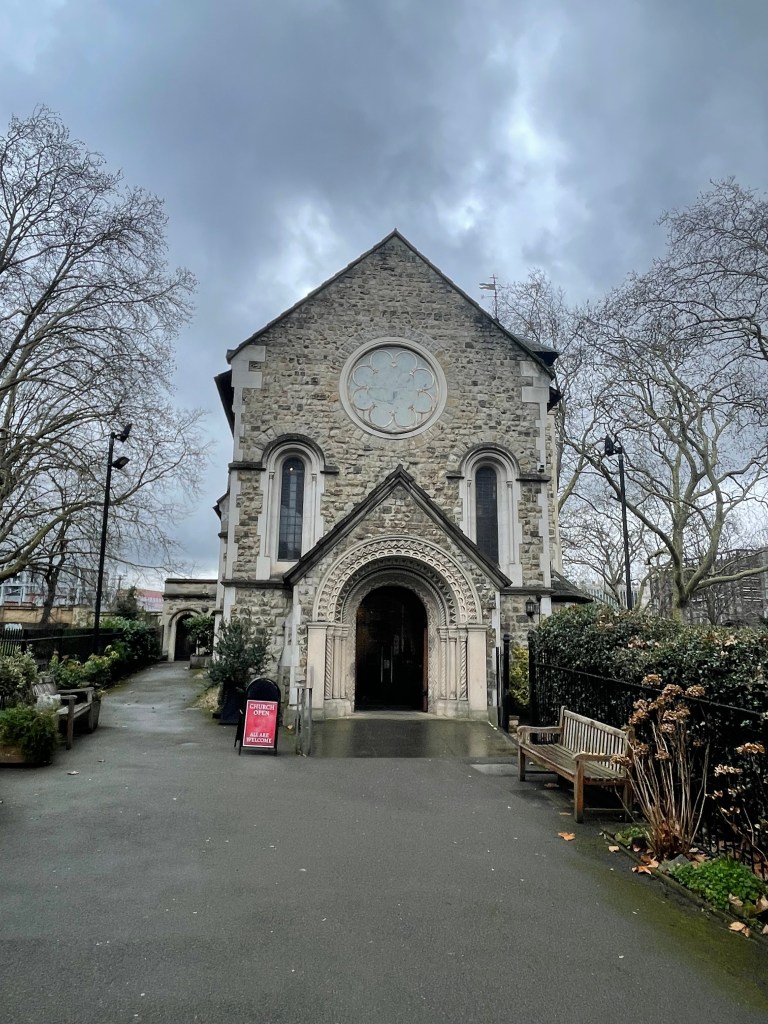
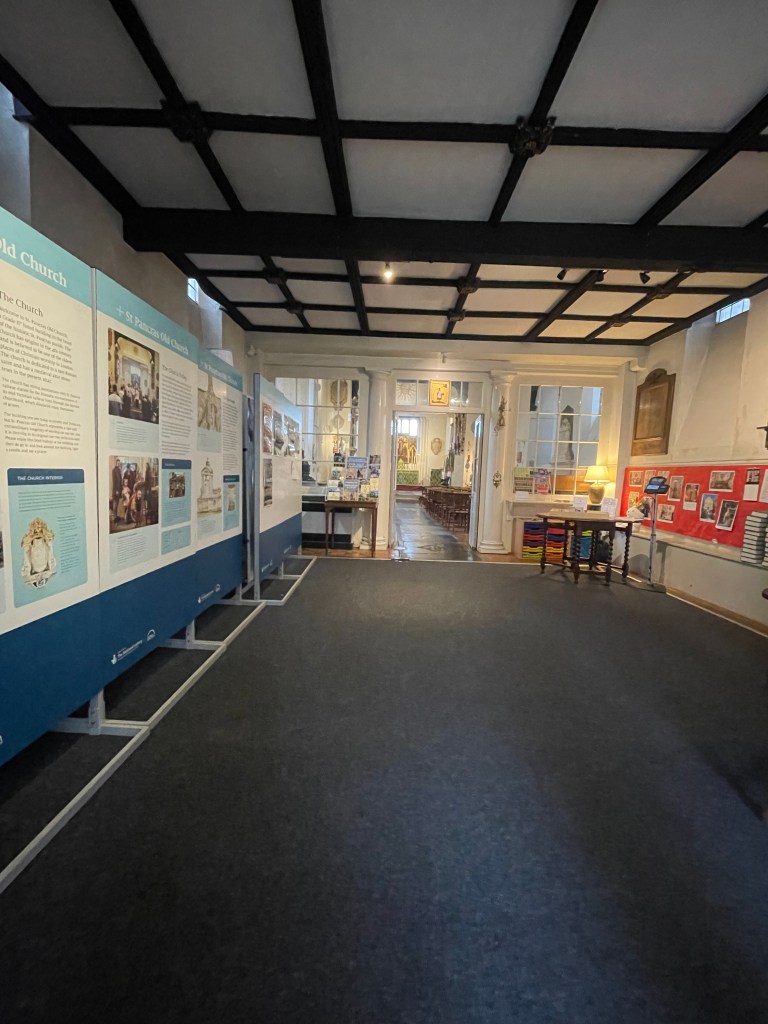
I reviewed different locations at and around the site (St Pancras Old Church), but ultimately decided on staging my installation within the lobby, as an evidently ‘in the way’ positioning.
I was pleased with the aesthetic of our presentation, and at various stages sent copies to my group for advice and approval. To be able to communicate effectively with the other members of my group, we created a WhatsApp chat between us where we discussed aspects of the project and what we personally would like to include in our own presentations of our work.
I enjoyed taking on a bigger role for this group project, and feel I coped well with managing my expectations and others’. I felt I managed others’ time well also, and that we were able to complete our presentation before the deadline, even allowing for some time before the pitches, to work on our physical presentation techniques.
One aspect I feel I could’ve divulged in more was the history of St Pancras Old Church itself. I had researched the site and the local area, however felt a little behind in what I felt I knew about it. However, one of my group members’ strengths seemed to be in history, specifically art and cultural history, and so the role of researching was more so delegated to them, whilst I ensured any relevant information for the brief was noted by all and made its way fittingly into the presentation.
Considering the feedback I was given about the non-site-specific nature of my piece, I have considered many things I could change about the proposed exhibition, and in particular my own work and ideas relating to the site-specific brief. I have contemplated the sizing of the displayed work, the space the booth represents, how the work is physically presented, and the location in which it’s presented.
Another idea I have had following this feedback would be to potentially scale the work down, and/ or set up more than one booth. By featuring multiple booths around the site (inside and out) it could be considered that I am staging various interventions along someone’s potential path to a higher power. Placing the self before anything higher and reinforcing my own personal contextual belief that we are all connected to a higher power and a sene of greater meaning – through our own inner dialogues, and the spiritual or meditative spaces we feel most comfortable in.
By scaling the work down, or up (although I prefer this option less from an aesthetic and logistical perspective) – I could play with the perception of power and control over the self and our moral values perhaps. With this in mind I would consider the unapologetic, defiantly personal nature of the piece in more depth. Perhaps even allowing for some evident sound bleed from the booth which (I regrettably forgot to mention in the presentation) is a key but, so far, overlooked part of my installation project. I will be interested to play with sound alongside the manifestation of a physical ‘perfect space’ as I progress with considerations on how I would like my work presented.
Despite not disliking these additional considerations – I feel I don’t want or need to change anything about the concept exactly. However; there are details I would like to add to the curatorial proposal, and to the presentation itself.
Firstly, I would like to have ensured the final design of my piece had been outlined clearly, listing the different immersive elements to it, such as the personal meaning behind the visual design within the booth, and the audio which would be playing from within. This I feel places my work more definitely into the space; and reaffirms that I am exhibiting my own sacred, safe space, within another (the church itself, albeit in the lobby area).
Secondly – given St Pancras Old Church’s long history, and the strong sense of community it offers the local area and population, alongside the exhibition I would like to propose a community engagement project focusing on creative lead well-being.
This could be something as simple as a one off workshop (or more), open to members of the local community, in which individuals are invited to create a self-expressive piece. Ultimately this can be anything, but prompts can be offered, such as ‘a self-portrait’, or ‘your happy place’; the focus being to enable people to acknowledge what makes them happy, as well as utilising creativity as a means of expression.
I feel this would be in keeping with the exhibition on the whole, as the focus for each member of my group’s work was self-expression and identity. Linking this to my work in particular, I wanted it to be possible to transfer my ‘safe/ happy space’ to any other location. I feel a church, particularly one with such a long, and active history within the community, is likely a considered safe space for many people, and it would be my hope to engage with pre-existing members of the community, as well as new persons who may have heard about the exhibition and workshop/s through marketing, word of mouth or are simply passing through.
I have outlined the additional material costs for workshops, and adjusted the budget accordingly.
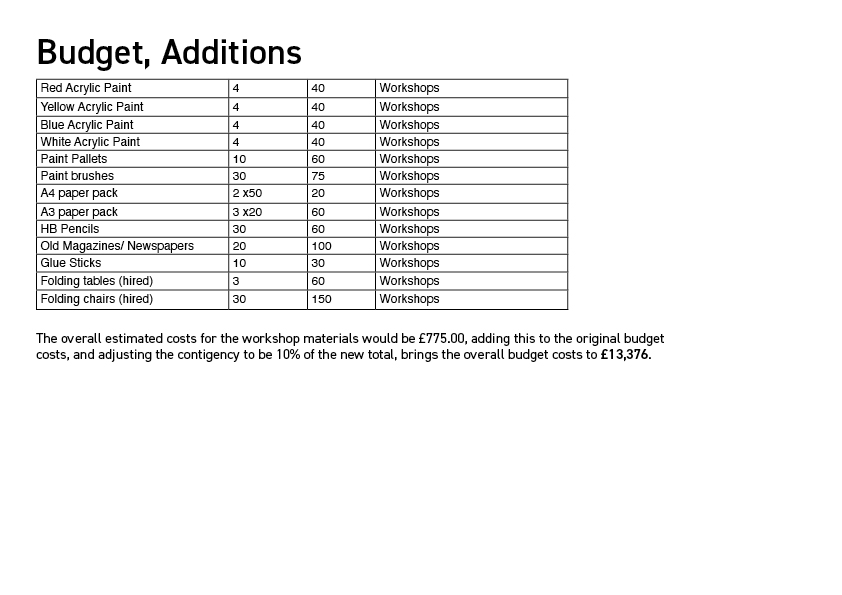
Although artists’ fees have previously been factored in, the creative well-being workshops would be a voluntarily offered program, facilitated by one or more artists. I have experience both partaking in, and leading creative workshops, as well as holding a valid, and up to date DBS certificate. I find community engagement within my creative practice to be very enjoyable, and very inspiring; so I feel I would also gain a lot from this experience.
It would be interesting to hear what the community themselves would consider valuable or useful in terms of group sessions, but to be more specific I think creative well-being workshops could benefit, aid, and advise a lot of people on how to look after themselves better, and to engage in their communities more actively. Above all else – these workshops would hopefully inspire people to be more creative themselves, to see the value in creativity, and to have fun.
 Squirrel M. Lambert