It’s common for me to have an influx of ideas that I start enthusiastically and don’t see through to the end before a new influx of ideas comes in and replaces the time I spent on the previous, and so on. As will be evident from reading my Creative Journal, I’ve had a lot of different thoughts and ideas relating to the brief ‘re-‘ and have definitely been overthinking it a lot… or maybe misdirecting my thought process into trying to fit the brief around other ideas I’d love to see to fruition.
As I was actively taking time away from thinking about the brief, to reset and physically clear out some unwanted things – I came across ten canvases that I had started work on previously but not finished; in fact it’s probably more accurate to say I had abandoned them. I’m a keen abandoner, and the quote, often attributed to Leonardo Da Vinci, that ‘art is never finished, only abandoned’, actually brings me a sense of relief. That I am not the only one who too often doesn’t know when to call it a day on a project I’m invested in. I think usually it’s largely to do with a certain standard I feel I never meet with my paintings, or if I do it’s a ‘happy accident’.
Before I begin painting I usually have no clear image in my mind of what the finished result will look like, although I often envision it being a photo-realistic style that I don’t end up achieving. In the past this has proved disheartening, and is a regular obstacle between me and any outcome. Due to this, and in order to try and avoid lacking an outcome for this project, I have set ‘rules’ for my plan to resume work on these ten paintings.
The conditions for completing the works:
- They must each be finished within one hour and thirty minutes from the point of resuming; after this time I must not touch the canvas – it is finished.
- I may break up, or spend, the time working on each piece as I choose to.
- I must use only acrylic paint and water, to ensure a faster drying time for the piece.
- I must not use a reference photo, or live study, and must paint from my mind and/ or my memory.
- I must keep to each piece’s original concept.
- I must not start a ‘next’ canvas until I have finished the one I am working on.
I have chosen to implement these conditions in order to aid my process, as the process itself becomes the focus. For this reason I am considering filming myself as I paint – as a starting means of recording or capturing my process as I paint. It is also a way of capturing every form of life/ layer that exists underneath my final outcome, as there are usually so many tweaks and changes that I often have to sand-down layers of unwanted paint when using acrylics.
Research & Influences
It is my understanding that every artist’s creative process is different and in the modern age there are many different ways to document one’s process. Many artists have used, and still do use, sketchbooks to draw, note ideas and paint in ahead of (or alongside) tackling a bigger project.
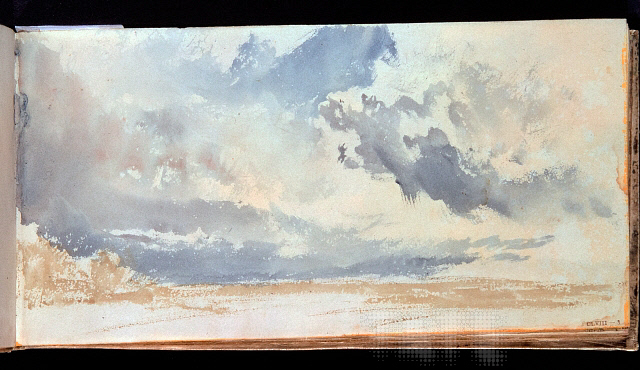
Notably JMW Turner used more than 300 sketchbooks in his lifetime to help capture details in aspects of his paintings.
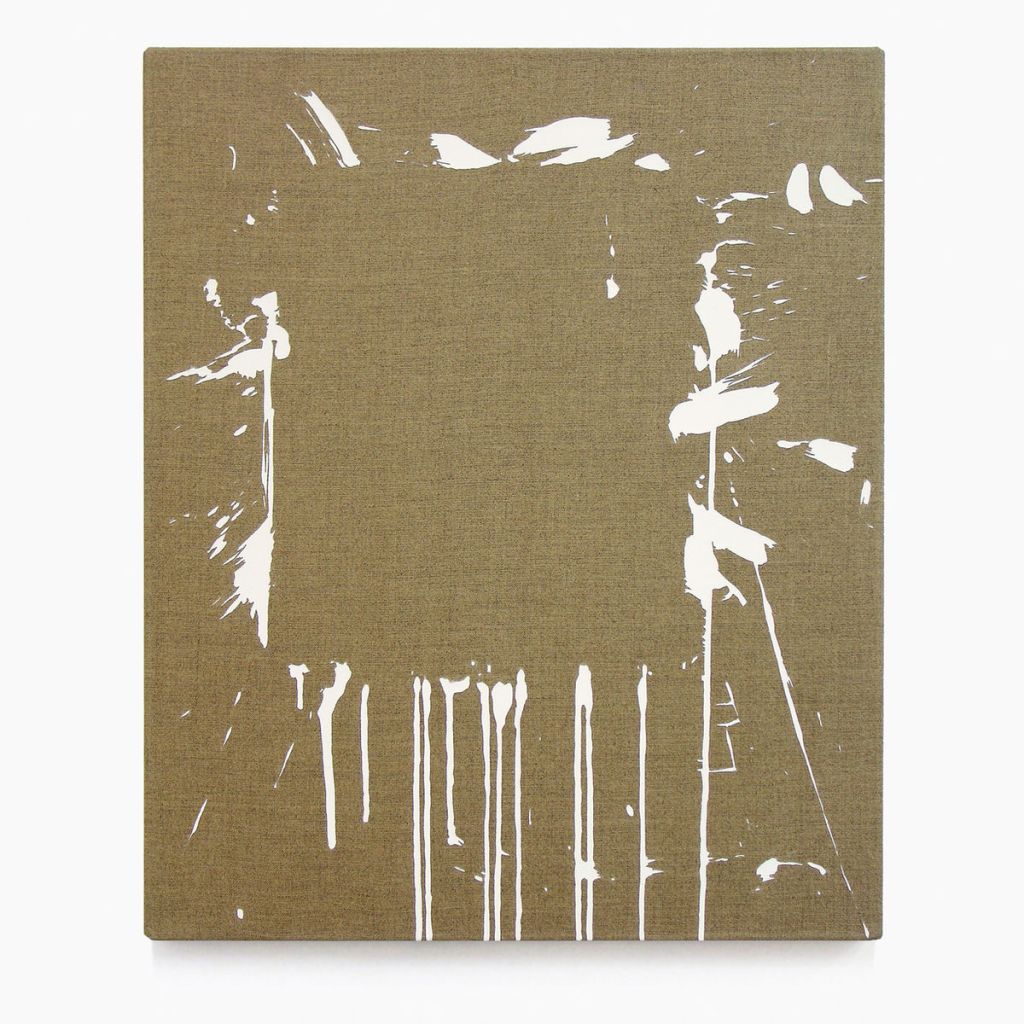
Other, contemporary artists, such as Ross Hansen (who is also one of the tutors on the FAD Fine Art pathway at WM College) use elements from the process itself as another piece of work altogether, or sometimes in combination. For example, this piece from 2014, titled Overspill, appears to be the literal overspill from one canvas onto another below or behind it. I really enjoy the idea that work literally can, and naturally does, extend beyond the canvas, or the final outcome.
I have been interested for a while in the documentation of my own process, considering the amount of changes any piece of work of mine takes. This particular idea actually came to me during a talk lead by another artist, and tutor on our FAD course, Steve Mepsted – who documented a part of his own FAD painting journey by taking a series of photographs of a large canvas as he painted and projected over it multiple times before returning it to white. The video of this particular project, titled ‘Skins‘ is available to view via the following link to YouTube – https://youtu.be/z0APNHE7Zsw?si=-zWfoBrpARQsM7J-
As a so-far self-taught artist, I can often feel out of my depth in the Art World, even or perhaps especially, as a viewer. I don’t think that this mental challenge to gain an understanding of what an artist sets out to convey through their process or their work is an instinct to shy away from. Moreover it usually increases my desire to learn as much as I can about an artist’s technique to attempt a better understanding of what they see on the canvas I’m looking at.
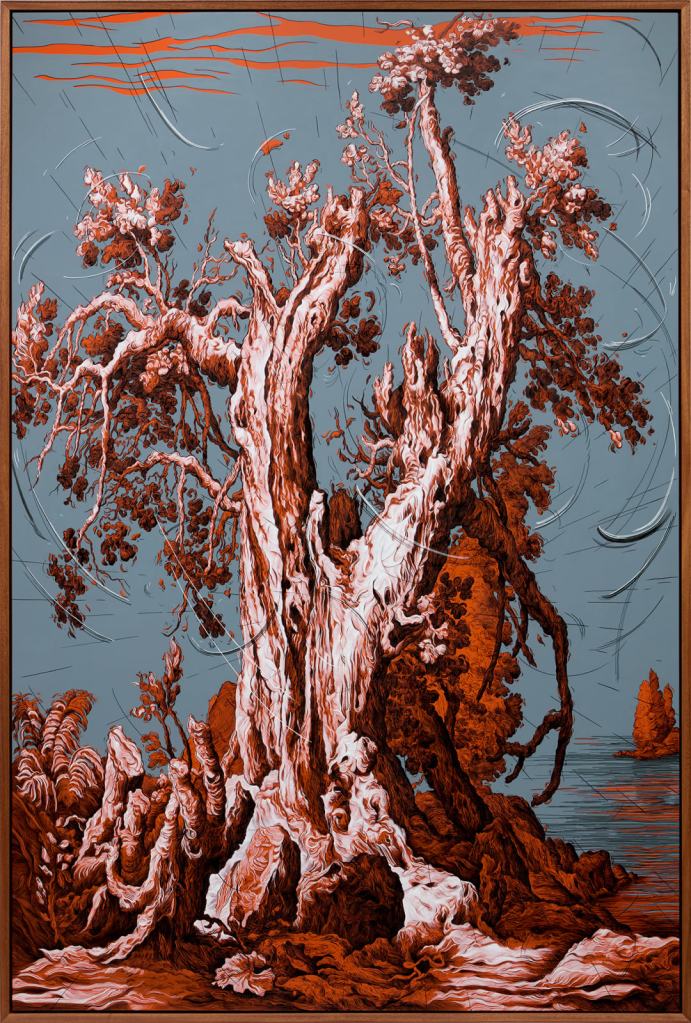
I enjoy the work of Glenn Brown, much of which is on display at The Brown Collection in London. The use of historical references feels almost elitist, as to me, images created by the artist give me a feeling of familiarity, as though the original were on the tip of my tongue, or somewhere near the front of my mental picture. For example, Brown’s piece So We Drove On Towards Death Through the Cooling Twilight, sits in a seemingly East Asian style – through my own mind. It sparks thoughts in me of cherry blossom trees and colour pallets akin to Japanese artwork I have previously seen but, again, can’t quite place the exact image in my mind as something other than I see it now through Glenn Brown’s work. I believe this was most likely intentional, as Brown describes ‘appropriations and oppositions’ as being key to his work. According to the websitehttps://gagosian.com/fairs-and-collecting/fairs/frieze-masters-2025-glenn-brown/, Glenn Brown was actually inspired to create this particular piece based on a sketch of a gnarled tree by Dutch artist Abraham Bloemaert – who himself was an influential figure within landscape art (another field I have my own experiences, and influences within).
Resume: Faye Dunaway
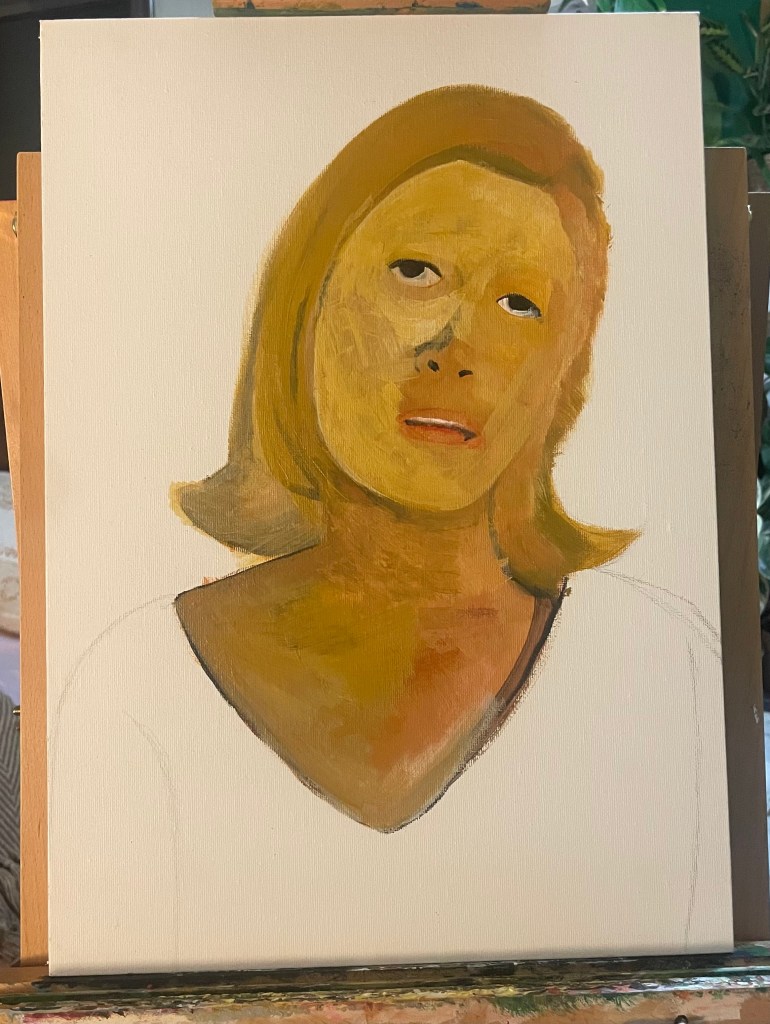
I started painting this portrait of the actress Faye Dunaway, taken from a film still from the 1967 film Bonnie & Clyde on an Insights Day at UAL Camberwell. I chose a particular still image from the film, when asked, because I had remembered liking the cinematography & grading of the film when I watched it many years ago. When I discovered we were going to paint our chosen images I felt anxious as I knew I would not be able to achieve the photo-realistic style that I usually wish to, due to the day’s time constraints and my own lack of ability to paint in this style.
I took the painting home at the end of the day and stored it under a sideboard, thinking I’d probably not touch it again, or that when I next did enough time will have passed for me to feel ready to either throw it away or recycle the canvas.
I often feel disappointed with my own ‘finished’ paintings as they feel only half of the experience I want the viewer to get from seeing my work. I find it difficult to leave a painting without words unless it’s completed in a photo-realistic style that leaves no unanswered questions about why something/ someone looks a certain way. To me, as much as I would like to paint in a realistic aesthetic, when I consider what this means to me, I know I want to spark interest and conversation that perhaps cannot be achieved through work that appears ‘perfect’, and leaves nothing questionable.
As I ‘resumed’ my work on this painting, I feel I was focused a little too much on having to change something. I spent the required 1.5 hours painting the background, as really I didn’t feel a need to retouch what had already been painted. Again, this is interesting to me as on the initial UAL Insights Day, and when I brought it home and stored it underneath a cupboard – I was not feeling in any way accomplished or proud of what I had done that day. I noted, in fact, that I felt quite embarrassed by the standard and style of my work in comparison to other artists’ work I could see.
By setting the goal to have completed work in each canvas within 1.5 hours has created a new way for me to view my process. As I neared the end of the first 45 minutes of painting on this piece, I felt as though to complete the painting was to cover each section of exposed canvas, and I rushed to do this and create a blurred, mostly green background to be reasonably true to the original reference image, in which the character of ‘Bonnie’, played by actress Faye Dunaway, stands beside a car on a country road.
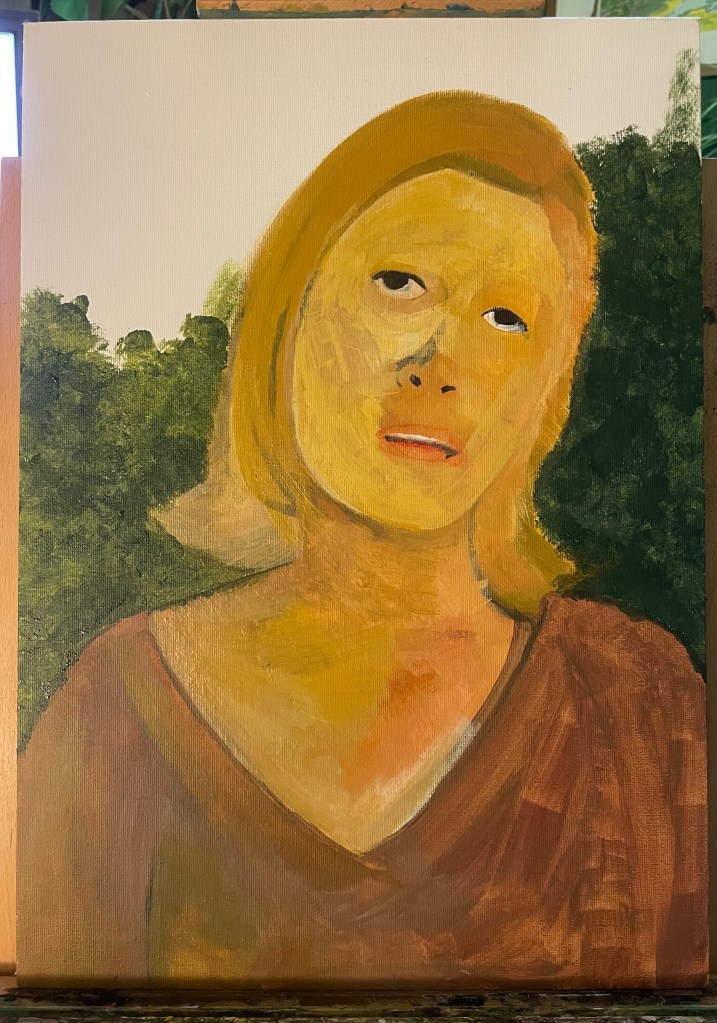
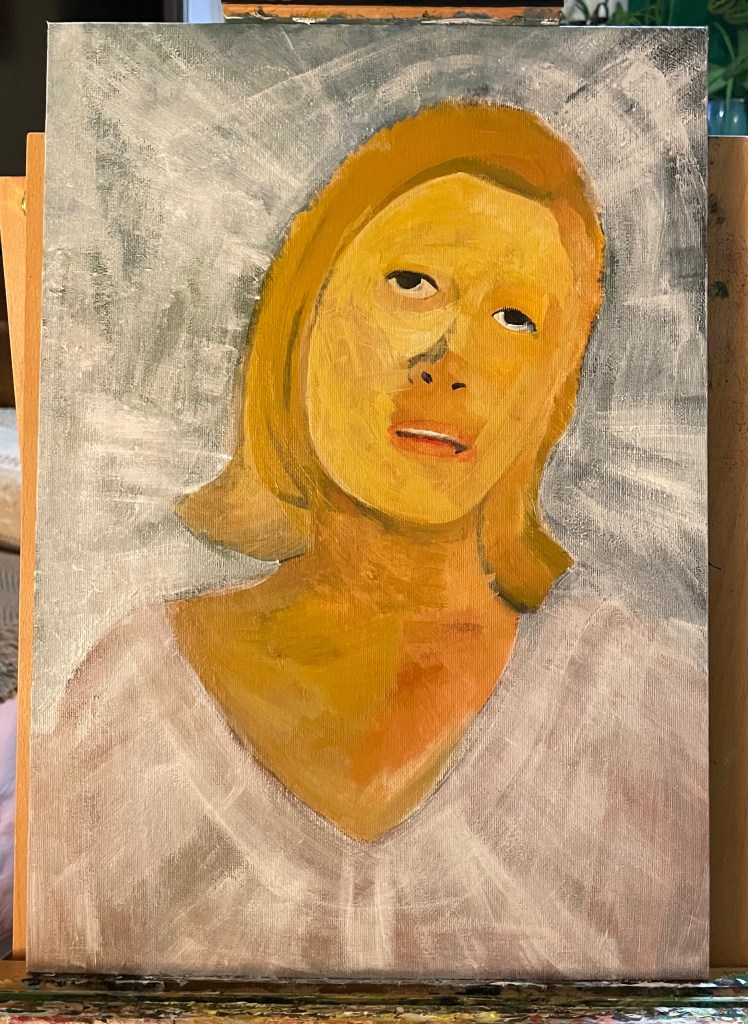
I then considered some feedback I had received when I first began the pairing at UAL Insights, that it was an interesting decision to crop the original reference image as I had – to only include ‘Bonnie’. This is because, to me, she was the main focus of the film still, her expression captured my attention and made me empathise with her character, from the expression in her eyes alone. I felt as though I wanted to ensure the viewer knows that, to me (the artist) the female subject is the most important aspect of the painting. To help literally convey this, I then covered the background in white, dragging my paintbrush in the opposite direction to Bonnie each time, in order to convey a sense of importance.
It, at first, was very tempting to change Bonnie’s face as I resumed work, as I felt unhappy with some aspects of the light reflections I had previously painted. Knowing I had a limited amount of time to complete the work helped me to leave certain aspects of the painting as they were. My focus was on highlighting Bonnie’s importance and the expression on her face as she stands rolling her eyes up to the sky. I chose later to add in yellow on top of the white, aiming to show two directions of light. I feel this is representative of the desires and concerns the character feels within the story/ film – should she stick with her lover and a life of crime, or lead a ‘normal’ life without him?
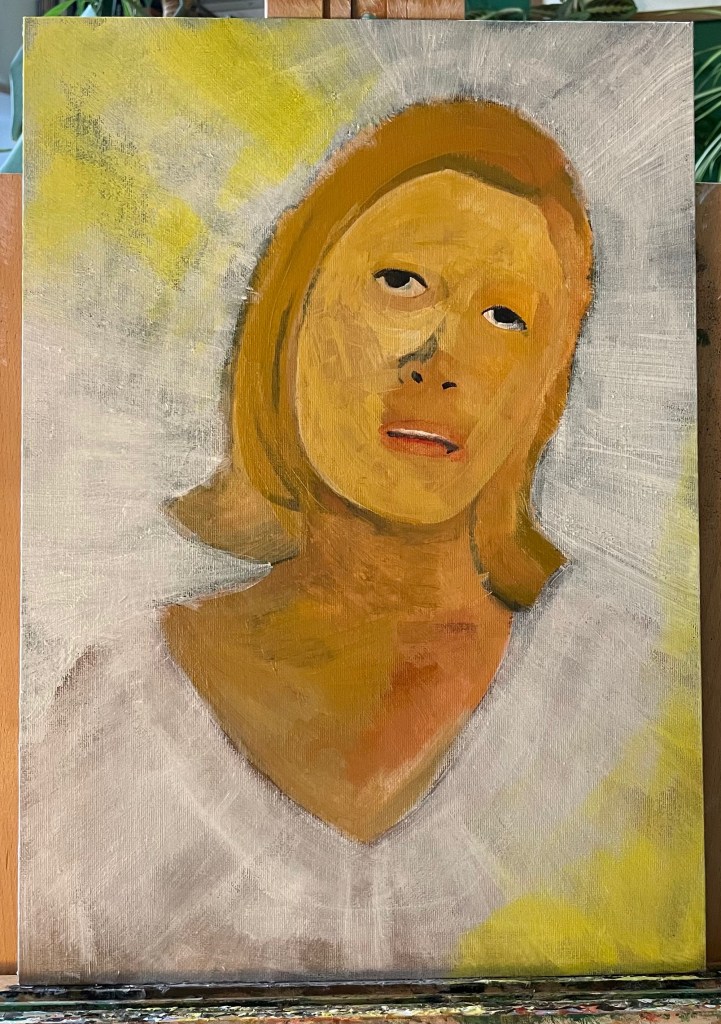
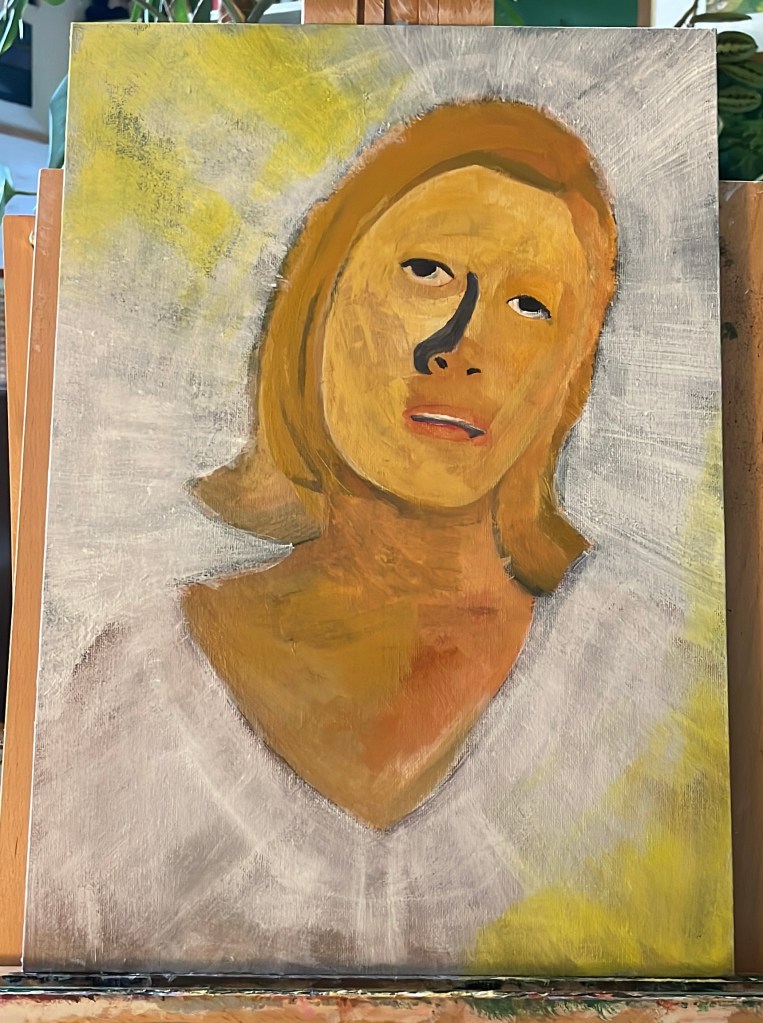
As I approached the end of my 1 hour and 30 minutes painting, I decided to allow myself one tweak to the original, painted Bonnie. I emphasised a shadow on her cheek; to make her facial features a little clearer, and as an impurity to the light on her face, as even if the character of Bonnie were to have given up her life with Clyde, she was at that point arguably already too invested.
Reflection Points
As I look at the now ‘completed’ painting it’s as though I can feel negativity oozing from the canvas. Although I am pleased with what I did to reclaim the white space, and to give emphasis to the subject’s face by directing all of my brushstrokes away from her, I feel in some ways mournful of the attitude I’ve held over myself throughout the painting of this piece. It is sad, in my opinion, that I have never in the present moment been satisfied with the work, however, that several times on reflection, I have enjoyed previous versions of the painting. If anything, I feel that by the end of the set painting time I tried to gain a quality or importance that I had lost from ‘resuming’ the painting at all, at least in the mindset with which I feel I approached this work.
That is not to say that I am altogether unhappy, or even that I regret sacrificing a perfectly useful canvas under a painting I feel so conflicted about. I have learnt a lot from this process, or in some cases reaffirmed what I already know I appreciate about painting.
I love that one, initial, idea can have so many possibilities through it’s life on a canvas.
I have confirmed to myself that I am not ‘bad at painting’, and I have grown my curiosity with regards the process itself. For this particular project, I now see the focus as the completely the process.
I understand that the psychological state I often enter into when I create is not conducive to a productive, healthy, and happy practice, and this is something I wish to now use other disciplines to explore and express.
Next Steps
Moving forward I wish to explore, and present a closer look at what happens to the canvas, and the artist, as painting work begins. In order to do this, I plan to continue ‘resuming’ painting on the previously abandoned canvases, in order to complete them as the initial idea. I will also set up two cameras in my regular, makeshift studio (which when I’m not creating, also functions as my bedroom). One camera, my DSLR, will be pointed at the canvas on which I am painting. The other camera, which I will use my Apple iPad Pro for, will be positioned to record my body as I paint.
How I choose to position myself as I paint changes depending on my mood and focus in any particular moment, and I may decide to repostition myself and the cameras if need be. For ease of set-up, and creative stamina, I will paint each canvas in a maximum of two, forty five minute sessions. As I get closer to the filming of my process, and my tasks other than painting are fewer, I may decide to refocus the amount of time I am able to spend painting in one session.
I have contemplated removing background objects, artwork, and other distractions from view as I record, however, I feel most comfortable and ‘ready’ to paint when in the familairity of my well-organised, spacious bedroom. As an interetsing exercise I will, for at least one canvas to be resumed, explore how it feels, and how I function in a completely different environment, perhaps one more social such as the Fine Art studio at WM College, somewhere outside, or in an isolated environment, free from distractions.
I feel ultimately that there is much more to explore in terms of how any artist documents their process/es and therefore leaves many more directions of expression for me to explore. At present, and following on from my research, I wish to explore the layers I paint beneath the final outcome.
I can also see an obvious benefit to practicing some aspects of a painting, such as light, colour tones, shapes, etc, in a sketchbook or roughly somewhere, prior to applying the paint to canvas (or board). Feeling as though I am more prepared for a piece has in the past proved useful in order to help direct a focus. I am aware of the saying ‘walk before you can run’, but personally am not sure this rule necessarily applies when creating. For me, – and please note that this comes before I begin to document my process as I now plan to, by filming both myself and the canvas as I work, – I feel so enthusiastically about the literal playing with paint to make a picture, that any vague plan or idea often gets forgotten about in place of a good time spent. In some ways I find this a more valuable experience than attempting to achieve any certain aesthetic. This is also why I wish to film myself as I paint. I’m quite unaware of how I must look when I’m concentrating on having fun, and most often becoming increasingly disheartened by the outcome/s. I think it will be an interesting experience to watch myself paint, in time with what I’m creating on the canvas with my brushes and my paint. I think it could even become a process of me recording my own reaction to watching myself paint, as this is the outcome and exploration I am most interested in at this time. As I continue to consider new ways of, essentially, documenting my own psychological state as I paint, I feel an extreme desire to just begin or ‘resume’ and literally see what happens.
 Squirrel M. Lambert