Influences
I considered hierarchical systems where positions of authority are valued or ranked. This lead me to consider schools, and the values they aim to impart on young people. Going into personal context for myself, school was an unhappy environment, and whilst I enjoy learning academically now, it certainly was not my focus at the time. Nevertheless, I feel I learnt some very valuable lessons whilst at school; a great many of them social. Thinking on this in recent years has lead to me consider the values society encourage in young people as they develop. Whilst education systems may do what (they say) they can, lessons are inevitably learnt socially in most school environments. There’s a lot I’ve tried to forget about my time in school, but a lot that remains ingrained in me regardless.
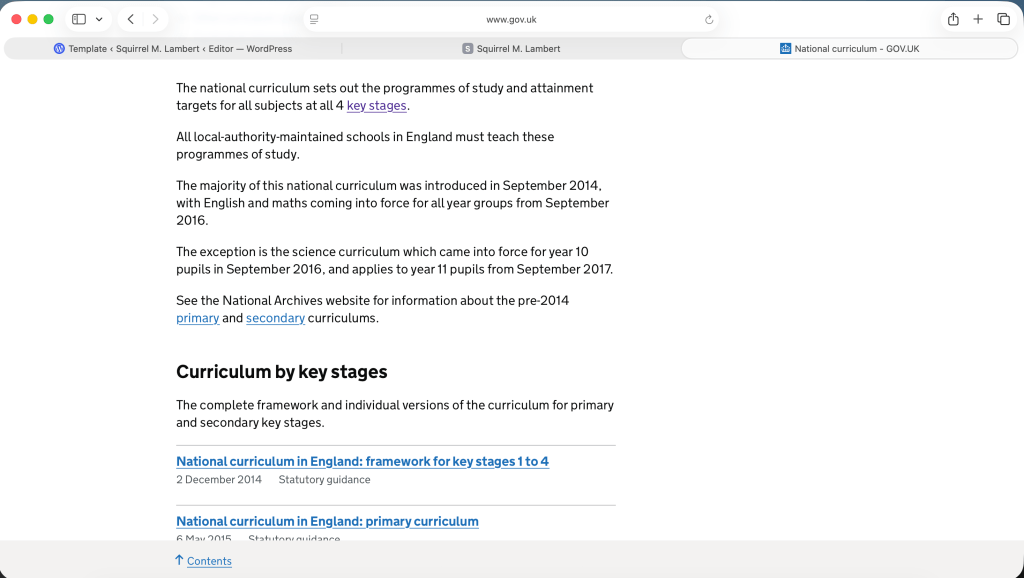
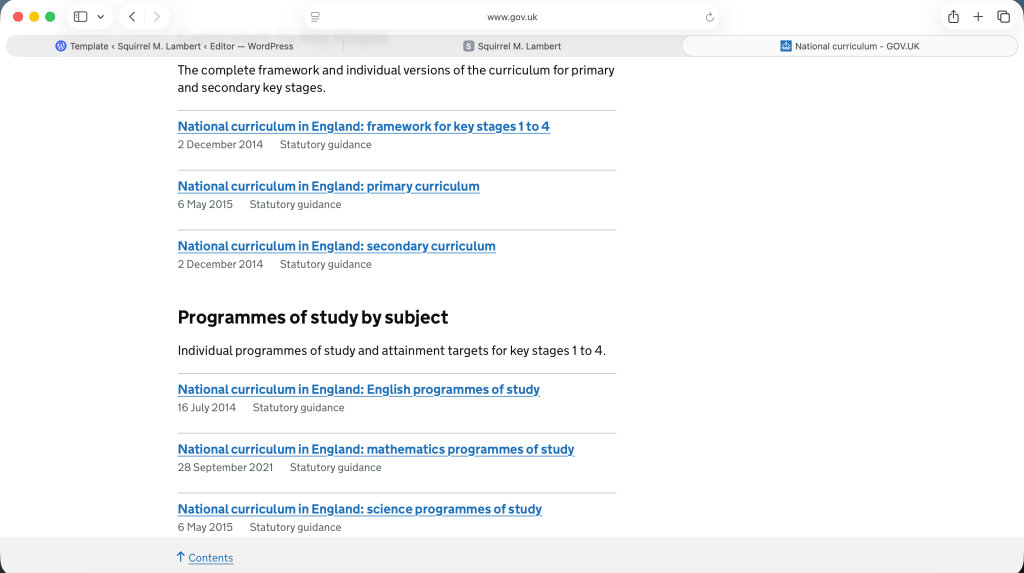
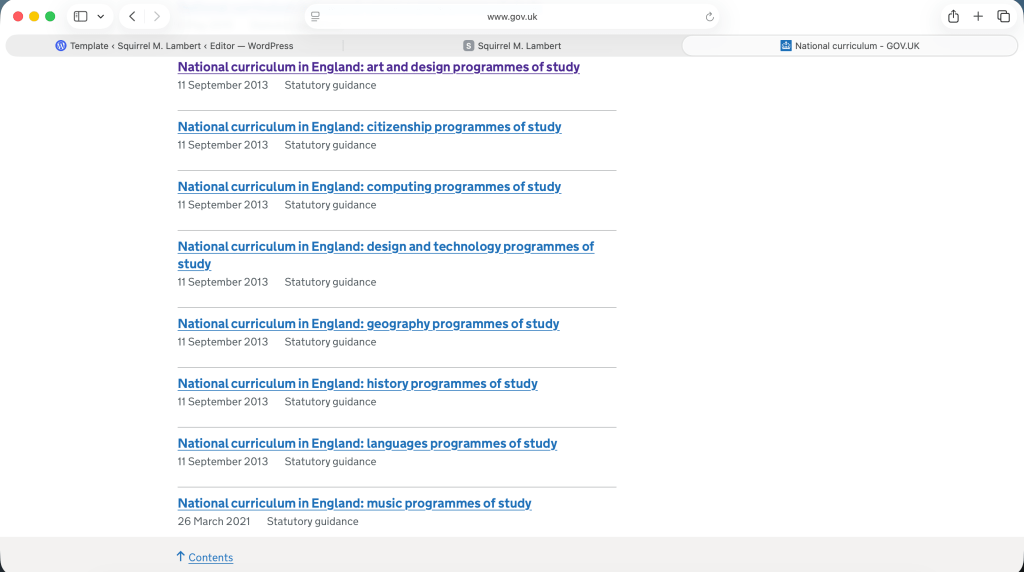
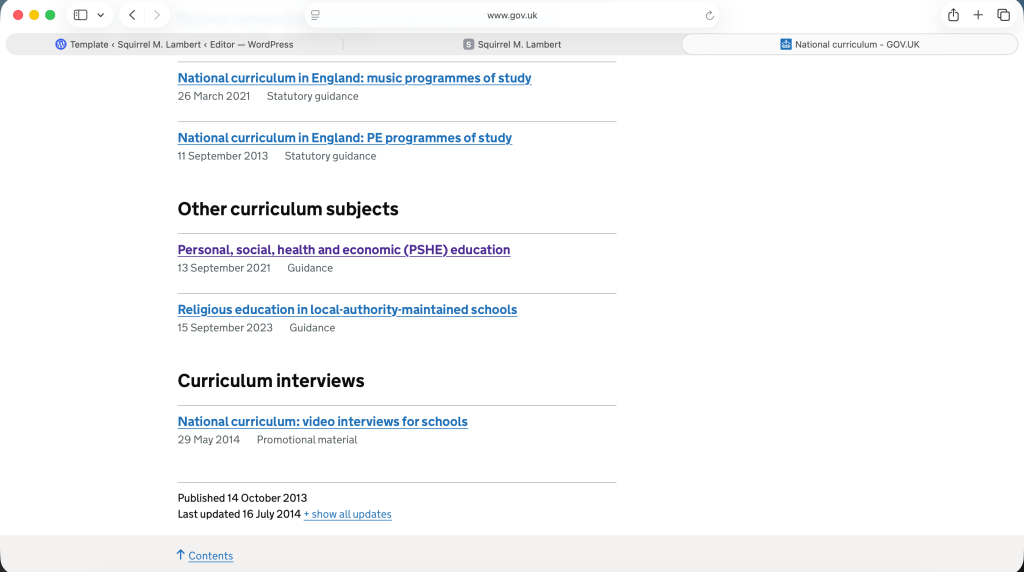
Furthering my research I looked up the National Curriculum online, through the government website, to better understand the academic expectations placed on young people under the age of sixteen.
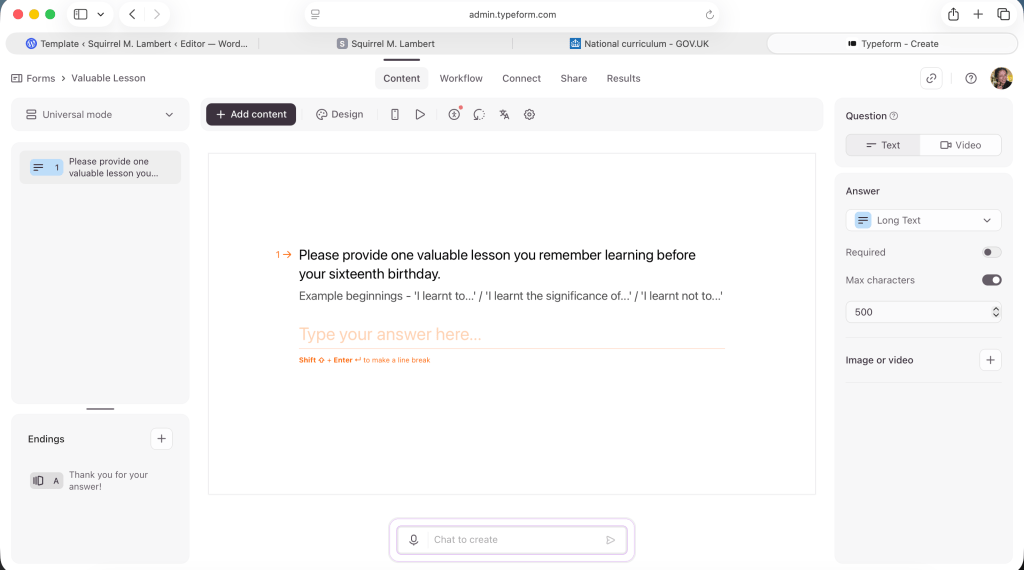
I also developed a one question, anonymous, survey, using the website Typeform. I sent the survey to several people and asked them to answer, and share the form as well. I wanted to make it anonymous so that people would perhaps feel more comfortable to say whatever came to mind for this prompt. I asked people to ‘provide one valuable lesson you learnt before your sixteenth birthday’, and set the character limit to 500. I was clear to explain this could be a moral lesson or a practical skill. My idea behind this still feels a little vague and I am now taking on research of other artists, plus children’s art as I’m hoping to gather answers and create pieces inspired by them. This may be illustration or painted, collaged, etc; or perhaps even shown somehow through video/s.
As I am now considering how moral values are presented to young people, I have been researching informational websites for children and young teens, as well as advice for parents.
For the first part I have looked at websites such as BBC Bitesize – which is a popular tool for learning in both schools and home environments. Mostly information seems to be conveyed through use of online videos, with the majority being interview-lead or animated cartoons. Websites such as the BBC aim to maintain a neutral, but fact-giving, stance on current events. Moral lessons are provided through articles relating to experiences, and exploration of people’s differences. These differences include things such as age/ generational differences (such as this article on school-experiences from pre 1950). I also found lots of information on religious beliefs and cultural traditions, likely intended to broaden young people’s mindsets and understanding. BBC Bitesize also has a whole section of its website dedicated to wellbeing, which is intended to aid personal development and self-understanding. I also feel engagement such as this can improve empathy and respect people hold for others and therefore become lessons in how to uphold worthwhile and healthy values as a human being.
As I consider ways moral values have been presented to children in the past, I researched stories and fables traditionally told. Aesop Fables seemed an obvious starting point, and I was surprised at how many I found listed online despite not having heard of most. Another book I was already familiar with is ‘Cautionary Verses for Children’, written in 1907 by Hilaire Belloc – a series of short poems that parody cautionary tales popular in the 19th century. Illustrated versions have been drawn by artists such as Quentin Blake, Nicolas Bentley, and originally B.T.B.
Different versions of Cautionary Tales exist, in the form of a podcast by Tim Harford, however these episodes are intended for listen to by adults, not children.
Doodled Lessons
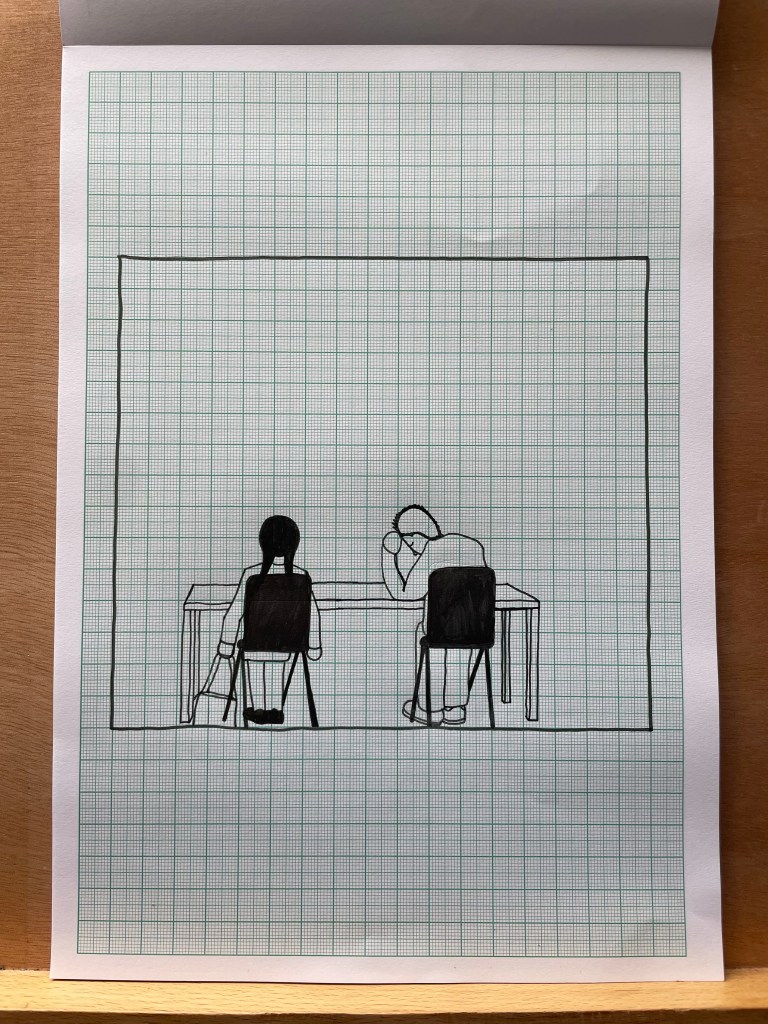
Having had a good amount of responses back for my survey, I decided to further my idea to illustrate my interpretations of each answer. To make the drawings feel more akin to that of school doodles, I first used a green graph paper and black fine liner pen. I wasn’t particularly happy with the aesthetic as I felt they weren’t very clear or well drawn in the short time I had decided to spend on them.
In order to keep experimenting, I transferred my drawings to Procreate on my iPad, where I began creating a stop-motion animation that would convey the lessons from each answer. I began with “to tell the time”,
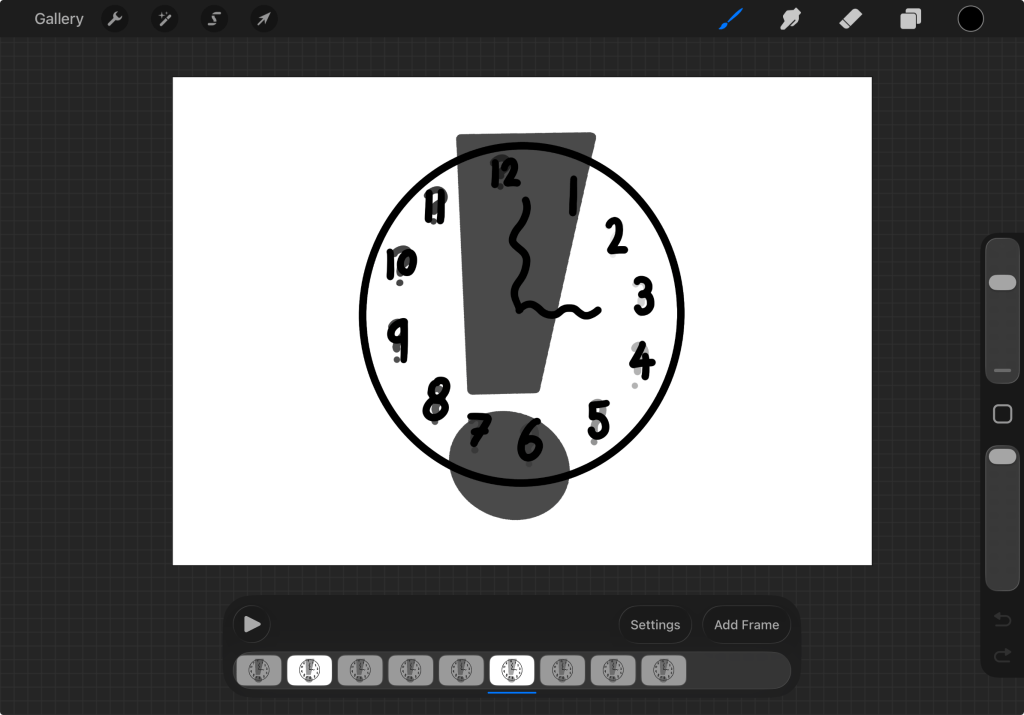
This proved to be quite time consuming on even the shortest response, and so despite liking the concept of creating a series of animated, short films, expressing moral lessons, I switched disciplines again, however, this may be an idea I go back to later if I feel it worthy to explore further, and have time within the constraints of the project.
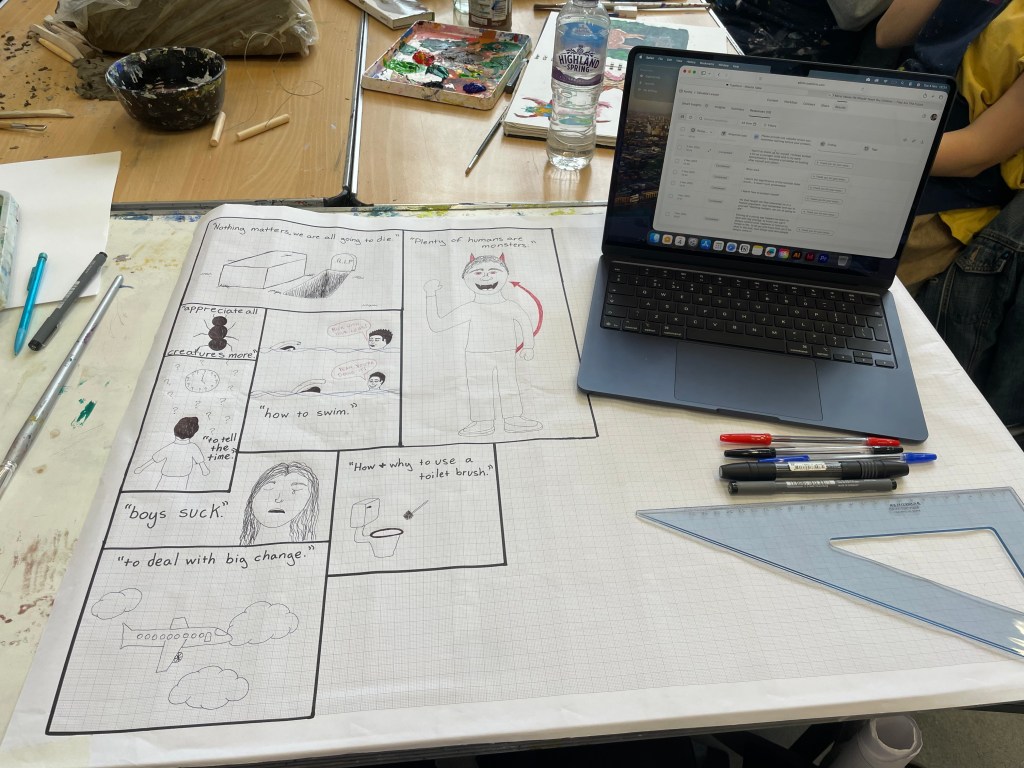
Although I was at first unhappy with the style of the drawings I had done, after reflecting on the idea with my tutor, I decided the aesthetic of a rushed, child-like, instinctive doodle was an effective way to show a raw feeling in response to, what were in some cases, significant valuable lessons. I am now continuing my work on the drawings, however have changed to drawing on a lighter coloured graph paper, and using various coloured, ball-point pens.
Reflection
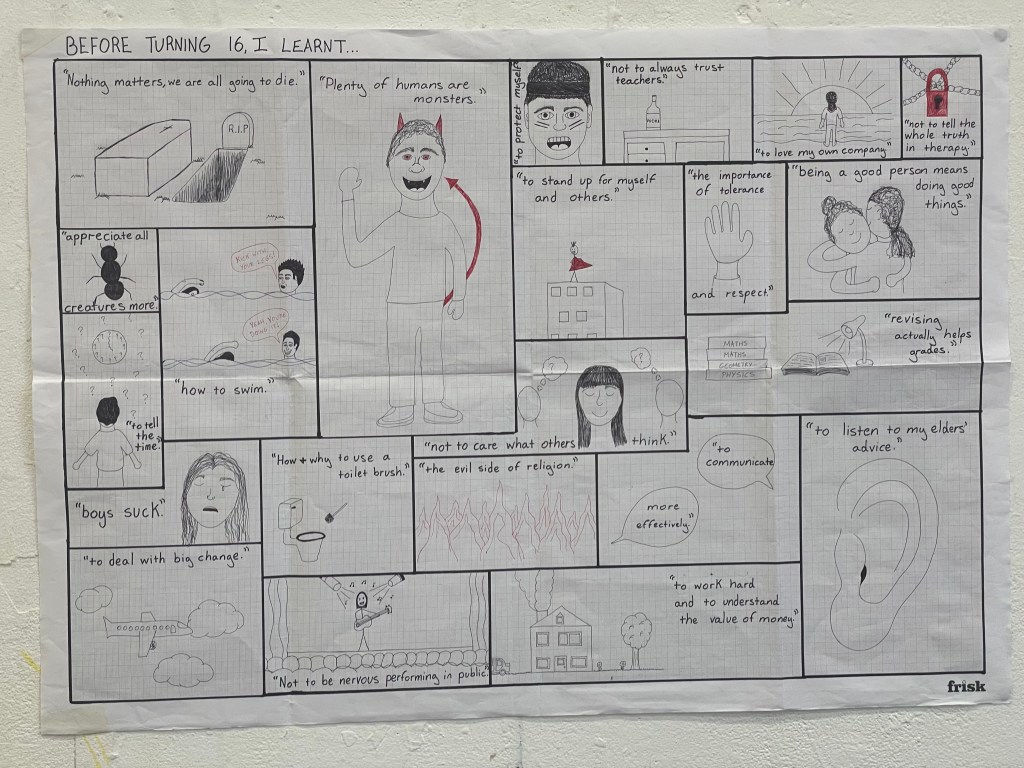
My piece is intended to look like something that could be passed around a school classroom as a shared doodle. I used graph paper, ball point pens and a marker pen, to give a school-days aesthetic, as these are common items of stationary used when at school. The act of doodling on graph paper felt rebellious, like passing a secret note around a classroom, or doodling on school paper instead of using it for work. I folded the A1 piece of paper in half a few times to fit it into my rucksack – much like I would’ve done with school work. I like the rough look to the piece, and the impression of it being collaborative, even though each drawing fits the same doodle style. The use of bluetac to stick the piece to the wall, prior to photographing, was a choice I made based on how I, as a teenager, would stick posters up in my bedroom at home. From house-moves, and changing styles – many of the posters I had up featured tears to the corners where I had previously lost elements of the poster to old bluetac or sellotape on walls. I was tempted to recreate the same effect with this piece, particularly because I wasn’t initially keen on the branding ‘frisk’ in the bottom corner of the poster. I decided to leave this in the end, as I felt the obvious stationary branding gave even more to the idea of something roughly put together in school-time.
My favourite of the drawings in this piece is the red padlock in the top corner. I chose to keep this box small, as I wanted it to feel restricted, or guarded to accompany the text “not to tell the whole truth in therapy”. My least favourite box contains text that reads “to protect myself”, this is only my least favourite because I forgot to leave enough space to write the words in, and so had to write them vertically along the image instead. This bothered me in terms of keeping the horizontal format the same throughout. During the making of this piece I felt moments of nostalgia – recollecting school days. I was surprised at how many people seemed to recount unhappy memories when prompted with the starting phrase “Before my sixteenth birthday I learnt…” however, amid even seemingly negative connotations such as “I learnt to protect myself” or “I learnt some people are monsters” – to me, evoked a sense of personal strength.
I really enjoyed creating the survey and reading back over the anonymous answers. Being able to involve other people in my art excites, and inspires me. If I had more time to work on this project I considered getting children (under the age of 16) to draw whatever came to mind for them with one of the given answers, and if I were to take this project further that is what I would like to do.
I find children’s art to be very freeing, and as young people’s imaginations are often more creative than adults, their drawings may have been much more carefree, and less censored than my own. This is perhaps because I felt pressures around drawing something that looked skilled or accurately representational. As the project progressed and I leant further into the idea – in fact, it was after I had to squeeze in the text “how to protect myself” – I lost a bit of my negatively inclined inhibitions and embraced that each drawing was rough, representational, and quickly drawn. I came to really like the end result, partly because of the simplicity, and size of the piece, and also because it provided (for me, personally) a lot of interesting lessons to consider on what I felt I had learnt by the time I was sixteen. A lot of the heavier context answers, such as “the evil side of religion”, had me considering privileges I had growing up, whilst answers such as “to love my own company” made me consider the personal skills and insight I had gained by that point in time. Receiving positive answers felt uplifting, and despite the anonymity of the survey, some people felt comfortable to make me aware of their answers – this to me felt mostly hopeful, as there were commonly positive answers from younger generations.
 Squirrel M. Lambert